




Hendrik Vlek DO – 28 February
Christopher Batten DO – 12 April
Marco Silvestre DO – 19 September
Miguel Otero DO – 31 October
Note: includes coffee breaks // lunch is not included
This training aims to equip the osteopath with critical tools for managing patients in different systemic states. At the end of the Masterclass, the trainee should be able to:
Still, A. T. (1899). The philosophy of osteopathy. Hudson-Kimberly Publishing Company.
Littlejohn, J. M. (1907). The Principles of Osteopathy. Chicago: American College of Osteopathy.
Wernham, J. (1986). The Practice of Classical Osteopathy. Maidstone: Maidstone College of Osteopathy Press.
Millard, F. P. (1922). Applied anatomy of the lymphatics. Journal Printing Company
Jänig, W. (2022). The integrative action of the autonomic nervous system: Neurobiology of homeostasis (2nd rev. ed.). Cambridge University Press.
Netter, F. H. (2026). Netter Atlas of Human Anatomy (9th ed.). Elsevier Health Sciences.
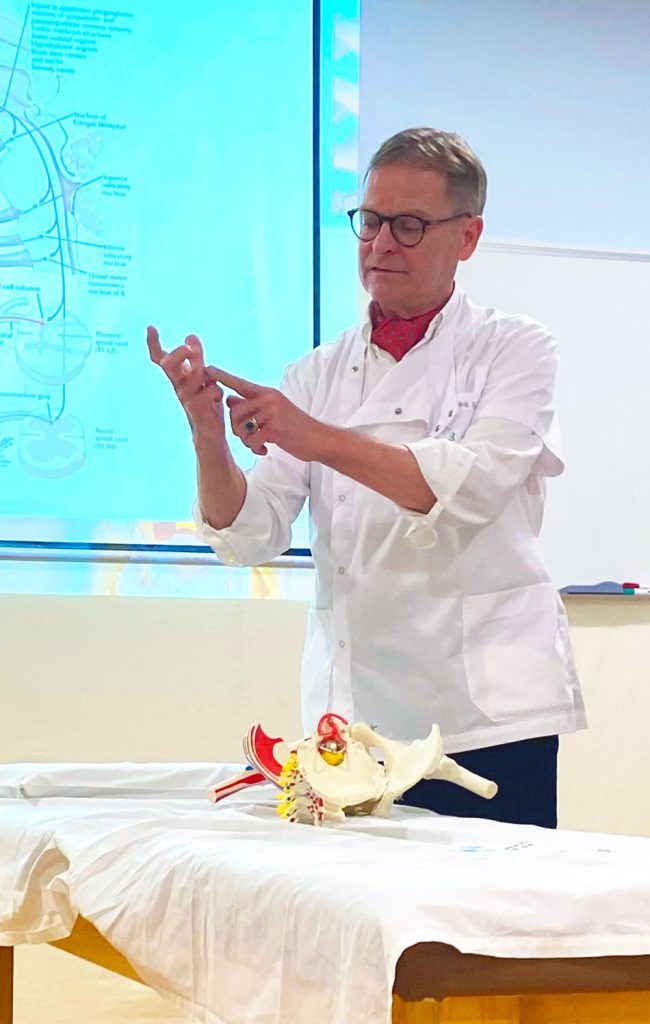
Following a degree in Physical Education and Physiotherapy at the Catholic University at Leuven (B), Hendrik studied at the International John Wernham Academy of Classical Osteopathy at Leuven (B) in association with the Maidstone College of Osteopathy (UK).
After graduation in 1995 he started an osteopathic practice in Sion Switzerland, where he also mentors since 1999, trainees of the Swiss School of Osteopathic Medicine. At this school he was expert for the final exams for more than 7 years.
Hendrik was one of the first osteopaths to pass the Swiss States Exam for osteopaths in 2008. He was actively involved in creating the Swiss Association of Osteopaths, and lectures on many of their post-graduate courses. Since October 2017 he mentors in his practice the trainees for the Swiss MSc in Osteopathy.
For many years, with a lot of pleasure, he also teaches at the ICO. In October 2017 and 2018 at the iO convention, in London, he was one of the speakers from the ICO team. He was also a speaker at online conferences from the ICO and AIOC and he made several demonstration video for the ICO and one for an online conference from the Osteopathic Alliance. In March 2024 at the 70th Anniversary Conference of the ICO, he was one of the leaders of a workshop and conference speaker.
He published some articles as well.
He’s married and together with his wife Sarah, they have 3 children.
Converting the Physical into the Physiological is where traditional osteopathy stops being mechanical and starts being medicine. This masterclass explores how skilled manual input—through lymphatic pump techniques, rhythmic circumduction, inhibition, stimulation and precise articulatory work—can shift tissue strain, fluid stasis, and neural irritation into coordinated physiological response. This moves beyond “freeing joints” and into restoring circulation, drainage, and reflex balance, demonstrating how structure becomes a gateway to function when handled with intent rather than force.
Participants will learn how to use movement, rhythm, and pressure to awaken lymphatic flow, balance autonomic tone, and re-educate soft tissues—turning restriction into response and compression into communication. Circumduction becomes a listening tool, lymph pumping becomes a systemic reset, and every contact is framed as a dialogue with the body’s inherent capacity for repair.
Christopher Batten, FICO Education Director at the Institute of Classical Osteopathy.
He graduated in 1989 from Maidstone College of Osteopathy under the guidance of the late John Wernham. He has taught pathology, osteopathic principles, and applied mechanics of the spine and pelvis at Maidstone College of Osteopathy since 1991.
From 1991 to 1993 he taught at the John Wernham International Academy of Classical Osteopathy in St. Joris-Weert, outside Leuven, Belgium.
Christopher regularly taught its undergraduate program until moving there for a full-time position in 1992 and 1993, teaching and managing the busy graduate clinic. In 1999 he was invited to teach at the postgraduate level at the Institute of Classical Osteopathy (ICO).
In 2000, Christopher was appointed co-president of the ICO and wrote its newsletter, later taking over the postgraduate course under the guidance of John Wernham. He later became Secretary of the ICO and is the current Director of Education. In addition to his roles at ICO, he now enjoys life as a traveling lecturer, teaching in various locations across Europe, Canada, Japan, and Russia.
He currently lives and practices in Toronto, Canada.
This masterclass proposes a rigorous and profound reflection on the role of osteopathy in autoimmune conditions, in light of Andrew Taylor Still’s concept, John Martin Littlejohn’s physiological systematisation, and John Wernham’s pedagogical transmission versus current science. It starts from the principle that osteopathy is not a set of directed techniques, but a concept conducted through a system of clinical thought oriented towards removing obstructions to the expression of “normal physiology,” even in the context of chronic immune dysfunction. The classical osteopathic approach does not aim to treat the autoimmune disease itself, but to understand how structural, circulatory, neurological, and adaptive alterations can condition the organism’s regulatory capacity.
This masterclass does not aim to teach isolated techniques, but rather to teach osteopathic thinking, applying and respecting the classical heritage and internal coherence of osteopathy as an integrated health system.
Marco is an osteopath, he graduated in Osteopathy at the I.T.S. – Universidade Lusíada de Lisboa (2007), in 2011 he graduated in Classical Osteopathy at JWCCO, England. He has served as director and assistant professor in the representation of JWCCO in Portugal.
Since 2009, in addition to clinical practice, he founded the Portuguese Institute of Classical Osteopathy – IPOC in 2015, where he currently serves as Clinical Director & Study Coordinator.
Classical Osteopathy and movement form an integrated approach that aims to restore the body’s overall balance through the direct relationship between structure and function. From this perspective, movement is not merely a result, but the essential tool for self-regulation and recovery of health.
Miguel is originally from Lisbon, where he currently resides. Since 2012, he has been translating/teaching Classical Osteopathy at JWCCO. He is also a teacher at the Olga Roriz Company. He considers himself passionate about the movements of life and the art of exercise.
In 2014, he completed a Postgraduate and Advanced Course in Classical Osteopathy (The John Wernham College of Classical Osteopathy – England).
And in 2011, he completed a Course in Osteopathy (Institute of Health Techniques).
Currently, he works in his private practice and in clinics in Lisbon.

Member of the Register of Osteopaths of France
Diploma in Osteopathy
University of Anatomy diploma applied to clinical examination and imaging
Former head of the Osteopathy course at the Collège d'Enseignement Traditionnel de Ostéopathie Harold Magoun
Former head of the Viscéral department at the Instituto Supérieur d’Ostéopathie Paris. ISOP
International Speaker
Author of the book: « Traité Pratique d’Ostéopathie Viscérale » aux éditions Frison-Roche
Author of the book: «Cahier d’Ostéopathie pelvi-périnéale» preface by professor François Desgranchamps head of urology service, Hôpital St Louis, Paris. Aux editions Frison-Roche.
Co-founder and administrative director of the anatomo-clinical training and evaluation school. EFEAC
Apesar de sermos uma instituição muito jovem, nem por isso nos devemos esquecer de que o que aqui fazemos é muito antigo, vem de muito longe e vai para muito longe: começou naquele dia perdido nos tempos em que pela primeira vez um ser humano percebeu que por detrás da biomecânica existia uma fisiologia imanente perante a equação da estrutura versos função e era obrigatório passar à geração seguinte a experiência e o saber que «o labor, o trabalho e a ação», como diria Hannah Arendt, lhe tinham proporcionado. Nesse dia longínquo, há dezenas de anos, esse ser humano deu início a uma das atividades mais belas e mais nobres da Humanidade: o ensino da Osteopatia.
É com o compromisso e o dever para com os nossos antecessores e alunos, que assumimos o ensino da Medicina Osteopática segundo os seus primórdios Princípios, com intuito na evolução e progresso do conhecimento.
Bem hajam ao IPOC.
O Diretor,
Marco Silvestre